Crypto Spot vs Futures Trading - Risks and Rewards
Spot trading in crypto involves buying and holding real assets for long-term growth, while futures trading uses leverage to speculate on price movements, offering higher potential returns but also greater risks. The key difference lies in ownership and risk exposure: spot investors benefit from time and stability, whereas futures traders face liquidation risk and require strict discipline, risk control, and clear strategy to succeed.
Table of Contents:
- ⚙️ What Is Futures Trading?
- ⚡️ The Hidden Risks of Leverage
- ⏳ Why Spot Trading Still Wins Over Time
- 💎 Core Spot Trading Strategies
- 🎯 When Futures Make Sense
- 🧘♂️🌱 Psychology, Discipline, and the Power of Patience
- 🚀 Conclusion
- ❓ FAQ
What Is Futures Trading? ⚙️
Futures are contracts that let traders speculate on a crypto asset’s future price without owning it directly. They enable profits on both market moves - up or down - by using leverage, which amplifies exposure.
With $1,000 and 10x leverage, you control a $10,000 position. If the asset rises by 1%, your balance doubles; if it drops by the same amount, you’re liquidated. At 20x leverage, even a 5% fluctuation can wipe you out.
Futures appeal because they offer quick results, but that speed comes with risk. Prices can swing 3–5% within hours on major coins and much more on altcoins, making small mistakes costly. Professional traders use futures for hedging, arbitrage, or short-term setups, always with stop-losses and defined limits. Without such discipline, futures trading becomes less about strategy - and more about surviving volatility.
The Hidden Risks of Leverage ⚡️
Leverage multiplies profits, losses, and emotions. A 10% move against a 10x position or a 5% move against 20x is enough to liquidate you instantly - a common event in volatile crypto markets. Even small fluctuations can trigger liquidation cascades, wiping out entire portfolios in minutes.
Another trap is the funding rate, charged every 8 hours to keep perpetual futures in line with spot prices. In calm markets it’s minimal (0.01–0.05% per cycle), but during volatility it can spike to 0.5–1%, draining 2–3% of your capital per day even if the price barely moves.
Most traders underestimate these costs and overestimate their control. Leverage heightens fear, greed, and overconfidence, leading to revenge trades and burnout. That’s why professionals use it sparingly - as a precision tool with strict risk limits - while long-term success still favors those who avoid turning trading into a high-speed gamble.
Why Spot Trading Still Wins Over Time ⏳
Spot trading is the foundation of long-term success in crypto because it’s based on real ownership. When you buy Bitcoin, Ethereum, or Solana on spot, you hold the actual asset - not a contract or a leveraged position that can be liquidated in seconds. There are no funding fees, no expiration dates, and no artificial pressure from margin requirements.
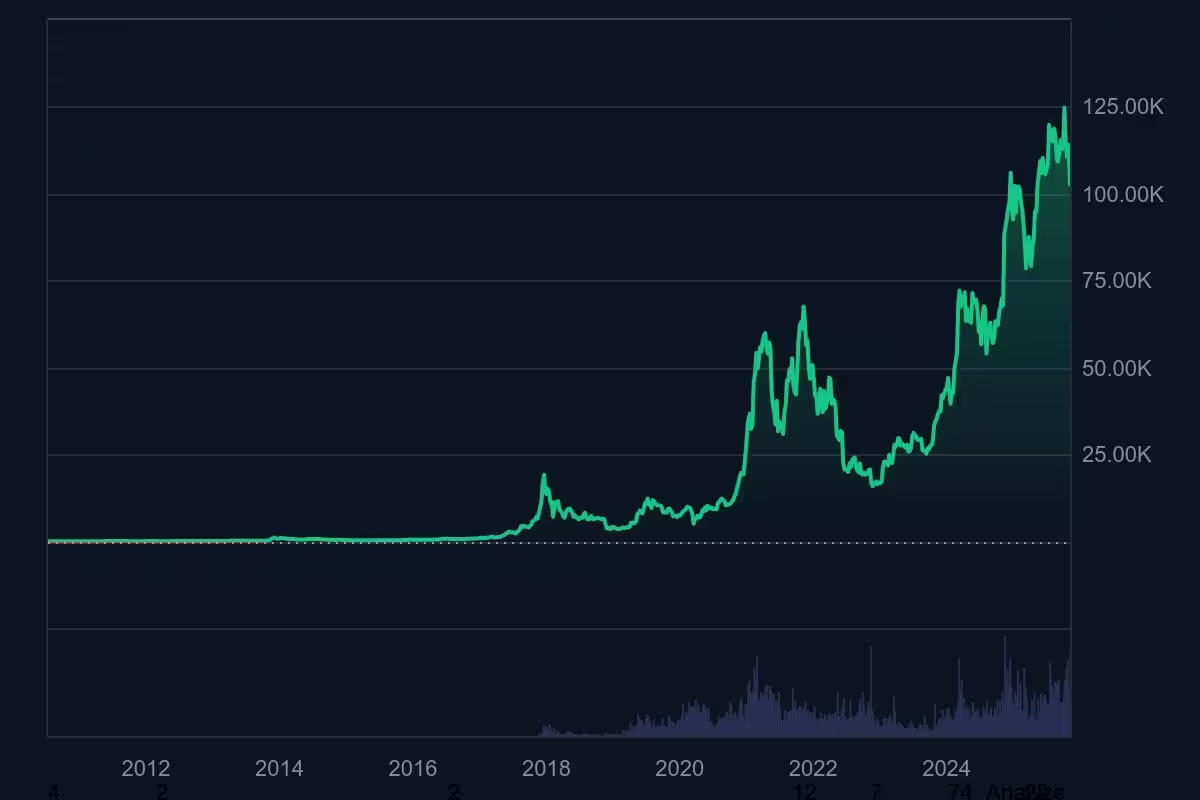
Historical data shows that time, not timing, is what drives results. Investors who bought Bitcoin at the very top of 2017 for around $20,000 saw their holdings fall sharply during the 2018 bear market. Yet by 2021, Bitcoin had exceeded $69,000, turning those “unlucky” buyers into long-term winners with a profit of over 240%. The same pattern repeated in other cycles: anyone who consistently accumulated BTC since 2015 has seen overall returns exceeding 10,000%.
Ethereum followed a similar trajectory. A $1,000 investment in ETH during its 2016 launch, when the price hovered around $10, would have grown to roughly $350,000 at the 2021 peak - a 35,000% gain despite multiple 80% drawdowns along the way. Solana, one of the younger assets, rose from under $1 in 2020 to over $250 within just 18 months before correcting - and still remains far above its early valuation.
The power of spot trading lies in time as your ally. Even after sharp downturns, fundamentally strong crypto assets tend to recover as adoption grows and supply diminishes. Holding gives investors the ability to average down during market dips, wait for the next cycle, and capture exponential upside without the constant risk of liquidation that futures traders face.
Spot trading rewards patience and conviction. Those who resist the urge to overtrade or chase short-term gains usually outperform leveraged traders in the long run - not because they predict the market better, but because they survive long enough to benefit from its inevitable growth cycles.
👉 Many long-term investors average down on corrections - see whether that’s smart or risky in Averaging Down in Crypto - Strategy or Trap?.
Core Spot Trading Strategies 💎
Spot investing isn’t just buying and waiting - it includes multiple strategic approaches suited for different goals.
- 🧭 Long-term investing (HODL). Buy high-quality crypto assets and hold them for years, trusting in blockchain adoption and scarcity-driven growth.
- 💰 Dollar-Cost Averaging (DCA). Invest a fixed amount regularly, no matter the price. It removes emotions and smooths out market swings over time.
- 🌊 Swing trading. Trade medium-term price waves lasting days or weeks. Buy pullbacks, sell rallies - but without leverage risk.
- 🧩 Pair or ratio trading. Focus on relationships like ETH/BTC. Earn from relative strength between assets instead of pure price moves.
- 🔄 Sector rotation. Shift capital between narratives - AI, DeFi, L2s, GameFi - following cycles of attention and liquidity.
These strategies favor discipline over speed and allow recovery after mistakes - something leverage rarely forgives.
When Futures Make Sense 🎯
Futures aren’t just for speculation - when used professionally, they serve important roles in managing risk, optimizing returns, and providing liquidity to the market. While risky for casual traders, in the hands of experienced investors or funds, futures can be a precise and powerful tool.
🧱 Hedging against short-term drops
Hedging is one of the most practical uses of crypto futures. Imagine holding 10 BTC worth $700,000 in your portfolio. If you expect a temporary correction but don’t want to sell your coins (to avoid tax events or miss future upside), you can open a short position on BTC futures.
If the price drops 10%, your spot holdings lose $70,000 - but your short position gains about the same amount, keeping your total portfolio value stable. Once the market stabilizes, you can close the short and keep your long-term coins untouched. This kind of hedge helps professional investors and miners protect capital during volatile periods without exiting the market.
🔍 Arbitrage opportunities
Futures also open the door to arbitrage, where traders profit from price discrepancies between markets.
For example, if Bitcoin trades at $70,000 on spot but $70,700 on a one-month future, you can buy BTC on spot and simultaneously sell the future. When the contract expires or the gap closes, you earn the $700 spread per BTC, regardless of price direction.
Institutional desks often run basis trades like this across multiple exchanges, generating annualized returns of 10–30% with minimal directional risk. The key is execution speed, accurate capital allocation, and constant monitoring of fees and funding rates.
🤖 Algorithmic and market-making strategies
Market makers and algorithmic trading firms use futures to provide liquidity and stability to exchanges. Their systems place thousands of orders per second, earning small profits from bid–ask spreads and funding differentials.
For example, a bot might buy perpetual futures and sell quarterly futures when a price gap exceeds a threshold, then close both when it narrows. Each trade may yield just 0.1–0.2%, but executed at scale, it compounds into significant gains.
These strategies require deep technical infrastructure, access to low-latency APIs, and strong risk management. They’re less about predicting trends and more about engineering consistency in unpredictable markets.
For most retail traders, however, these uses of futures are too complex and capital-intensive. Without automation, institutional-grade tools, or a disciplined framework, the same leverage that helps professionals hedge can easily magnify small mistakes into major losses. Futures can be valuable - but only when they serve a defined purpose within a structured system, not as a shortcut to fast profits.
Psychology, Discipline, and the Power of Patience 🧘♂️🌱
In crypto, the toughest opponent isn’t the market - it’s your own mind. Most traders lose not because they lack knowledge, but because they lose control. Overconfidence after a few wins, panic during dips, and the urge to “make it back” after losses create a cycle of emotional decisions. Futures amplify this behavior: leverage turns small moves into big emotional shocks. Spot trading, on the other hand, gives you space to think, plan, and recover - it rewards consistency, not adrenaline. Long-term winners in crypto share one thing in common - discipline. They follow clear, repeatable principles that protect capital and keep emotions in check.
Core Principles for Smart Crypto Trading 📚
- Position sizing. Never risk more than 10–20% of your portfolio on a single asset. Diversification limits the damage from any one mistake and helps you stay in the game long enough to win.
- Defined time horizon. Know from the start whether you’re entering a short-term trade or a long-term investment. A trade without a time frame quickly becomes emotional improvisation.
- Understand what you buy. Study the fundamentals - tokenomics, team, use case, and market demand. Buying a coin just because it’s trending is speculation, not strategy.
- Emotional control. Fear and greed destroy focus faster than bad analysis. Set rules before you trade - entry, exit, and stop levels - and stick to them even when it’s uncomfortable.
- Liquidity reserve. Always keep a portion of your portfolio in stablecoins. They act as dry powder for new opportunities and help you buy dips instead of watching them helplessly.
- Consistent evaluation. Review your trades monthly. Note what worked, what didn’t, and why. Treat trading as a process of refinement, not a series of random bets.
- Avoid overtrading. You don’t need to be in the market all the time. Patience often produces better entries and calmer decisions than constant action.
Futures can reward speed, but they punish mistakes instantly. Spot investing, by contrast, rewards those who stay disciplined, manage risk, and think long-term. The slower approach may not look glamorous, but it compounds quietly - and in crypto, time remains the most powerful form of leverage.
Conclusion 🚀
Both spot and futures trading are essential parts of the crypto ecosystem - but they serve different goals. Futures can be powerful tools for professionals who understand risk, use hedging, or run algorithmic systems. For most investors, though, spot remains the safest and most sustainable way to build long-term wealth.
Patience, planning, and discipline consistently outperform leverage and hype. In crypto, survival equals success: those who manage emotions and protect capital live to profit from the next bull market.
Time, not timing, is what separates traders from investors - and investors from gamblers.
FAQ ❓
What’s the main difference between spot and futures trading?
Spot trading means owning the actual crypto asset, while futures let you speculate on its price using leverage. Spot has no liquidation risk, while futures can amplify both profits and losses.
Can I really make money with leverage?
Yes, but only with strict risk control. Even small price swings can wipe out a leveraged position, so futures should be used sparingly and with a clear strategy.
Why do institutions use futures if they’re risky?
They use them mainly for hedging - to protect large spot portfolios from short-term drops - or for arbitrage, capturing small, low-risk spreads between markets.
Is spot trading better for beginners?
Absolutely. Spot investing is simpler, safer, and helps you learn market behavior without the pressure of liquidation or funding fees.
How much leverage is safe?
For most traders, anything above 3x is already high risk. Professionals often stay under 5x, while beginners are better off avoiding leverage entirely.
What’s the best long-term crypto strategy?
Focus on quality assets, steady accumulation (DCA), and emotional discipline. Avoid constant trading, hold part of your funds in stablecoins, and think in cycles, not in days.